Phase 2 starts 1 July 2027 and will complete 1 July 2029.
At the heart of Phase 2 are the co-design innovation cases, bringing together all relevant stakeholders, real-world contexts, and supportive technologies. Which technological innovations will we design? How can we support the design process with state-of-the-art co-design tools? And how do we truly engage in neuro-inclusive responsible research and innovation? Through several hands-on, practical co-design case studies, conducted in close collaboration with the COINTEND consortium, Phase 2 is geared toward a concrete set of technological and conceptual outcomes.
The University of Twente will work closely with its partners to conduct two to four co-design innovation case studies. Each case study will last between twenty and forty weeks, during which the team will conduct user tests of existing supportive technologies and develop two prototypes of novel supportive technologies. What these novel technologies will look like is still largely open: ranging from interactive play materials to communication-enhancing furniture, their form and function will be determined in close collaboration with all stakeholders through creative co-design processes. Building on new insights from these case studies, the UT will also present a second iteration of design principles for embodied social interaction.
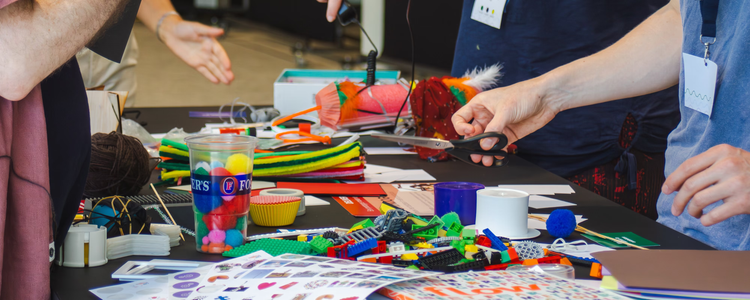
The HU University of Applied Sciences Utrecht will support these and other case studies by focusing on the selection and adaptation of co-design tools, methods, and techniques to ensure that all stakeholders have a voice in the design process - from neurodivergent children to parents, teachers, and healthcare professionals. To this end, the HU team aims to develop a prototype of a co-design toolkit for neurodiversity. In order to get there, the team will join the other research institutes in making observations during the case studies and will organize focus groups to gain additional insights. Across all case studies, the HU team will additionally map the design competencies of the stakeholders involved and represent these competencies in a model.
The HAN University of Applied Sciences will continue its work on creative arts and psychomotor therapies (CAPTs) in a virtual reality environment. Together with its partners, the HAN team sets out to create a novel application of a virtual reality environment that is specifically tailored to support CAPTs. The development of this application will involve multiple iterations and various stakeholders, including neurodivergent children, therapists, and adult experience experts. To ensure that all stakeholders can contribute equally, an experimental testing platform will be designed to explore and co-design concepts, as well as test and evaluate prototypes together.
Like the University of Twente, Delft University of Technology will take the lead in at least two co-design innovation case studies. Together with participating schools and families, the TU Delft team will use these case studies to explore how supportive technologies for embodied social interaction can be implemented in real-world contexts. Moreover, at the process-level, the TU Delft team aims to identify best practices, hurdles, and opportunities for neuro-inclusive technology development - insights that will enrich the research activities of the other institutes. Finally, through ethnography and in-depth interviews, the team will also investigate whether and how technological mediation can help reduce stress, improve self-esteem, and foster social connectedness among the interacting partners.
As in Phase 1, the Radboud University Medical Center will play an overarching supportive role. Radboudumc, represented by Prof. dr. Wouter Staal, will contribute to substantive, methodological, and ethical decision-making throughout the case studies and provide a critical perspective from which to scrutinize the outcomes.